Stepping vs Raking: How Fence Alignment Affects Time and Cost
What “Stepping” and “Raking” Actually Mean
On sloping ground, a fence has to deal with changes in level. There are two ways to do that: stepping or raking.
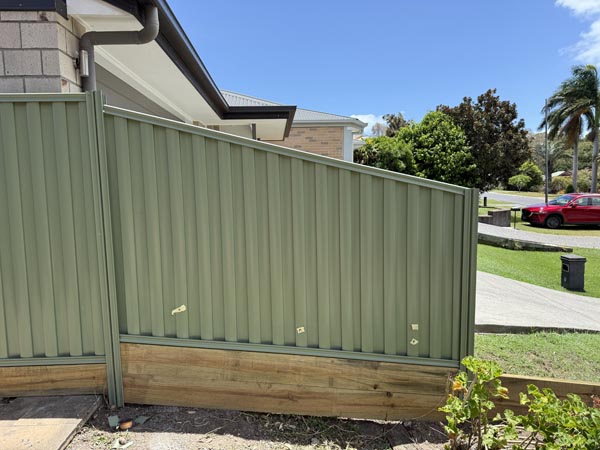
A stepped fence keeps each panel level. As the ground falls or rises, the fence drops in small vertical increments. Each panel remains square and uncut, creating a clear stepped profile along the bottom.
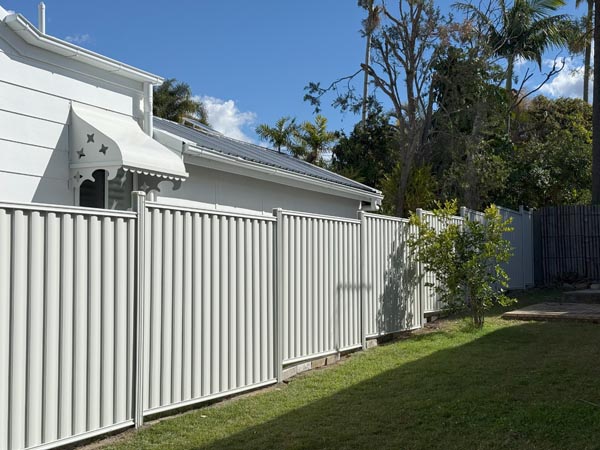
A raked fence follows the slope. The panel is installed at an angle so the top and bottom lines track the ground continuously. To achieve that, the sheets and rails must be cut to suit the slope.
Both methods are valid. They just solve the same problem in very different ways.

Why Stepping Is Faster
A standard Colorbond panel consists of two posts, a bottom rail, a top rail, and three infill sheets.
With stepping, nothing needs to be modified. Once the posts are set and the concrete has taken, the panel simply drops into place. Installing a stepped panel typically takes around five minutes.
The bulk of the time is in digging the holes, pouring concrete, and plumbing the posts. Once that’s done, progress is rapid and predictable.
Why Raking Takes Much Longer
Raking changes everything.
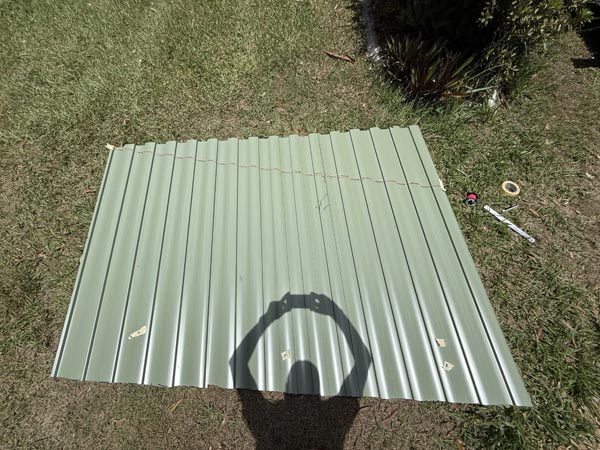
To rake a panel, the sheets need to be cut on an angle, usually at both the top and the bottom. The rails must be trimmed to match. Every cut has to be accurate or the fence will look twisted or uneven once installed.
What takes five minutes when stepping can easily take up to thirty minutes per panel when raking. That is a sixfold increase in installation time for the same length of fence.
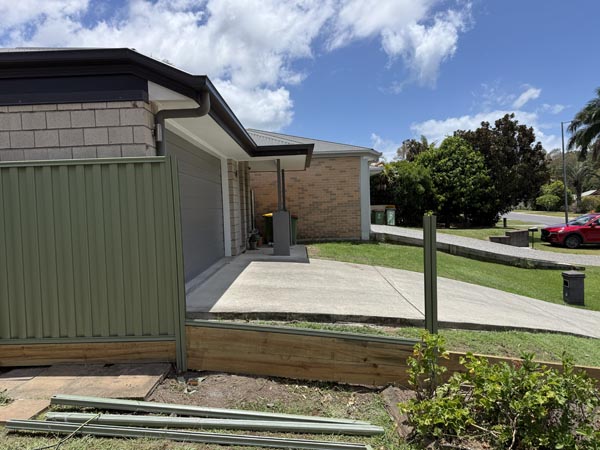
This extra time is pure labour. The materials don’t change much. The workmanship does.
The Cost Implication
Fencing is priced around labour as much as materials. When installation time per panel increases, the effective hourly rate on the job rises with it.
From a homeowner’s point of view, this is where confusion often comes in. Two fences of the same length can attract very different prices purely because one is stepped and the other is raked.
Stepping allows predictable production. Raking introduces slow, careful cutting and fitting at every panel.
Visual Differences
Stepping creates a clean, geometric look. The panels stay square, and the slope is expressed as a series of level drops. On many sites, particularly with modest falls, this looks deliberate and tidy.
Raking creates a continuous line that mirrors the ground. Some people prefer this visually, especially on gentle slopes where the angle is subtle.
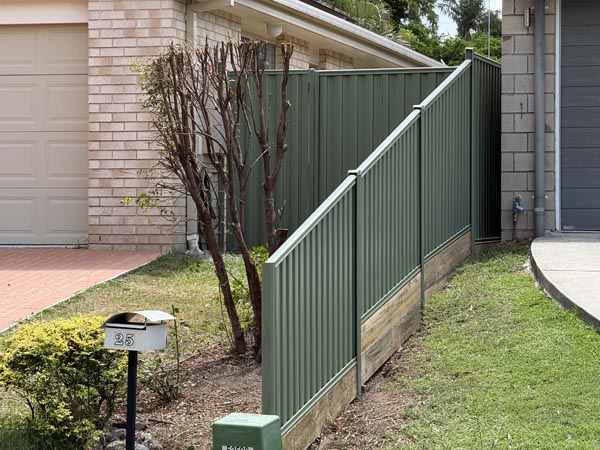
On steeper ground, raking can exaggerate the slope and draw the eye to it.
Neither approach is right or wrong. It’s a design choice with practical consequences.
When Raking Makes Sense
Raking is often justified when:
- The slope is shallow and continuous
- The visual priority is a straight top line
- The client understands the added labour cost
In these cases, the extra time spent cutting and fitting can be worthwhile.
When Stepping Is the Smarter Choice
Stepping is usually the better option when:
- The slope is moderate to steep
- Budget matters
- Speed and consistency are priorities
- Minimal cutting and future modification are preferred
Stepped panels are also easier to replace individually if damage occurs later.
Planning for Slope at the Quoting Stage
The key point is that slope is not just a site condition. It is a labour multiplier.
When a fence is priced accurately, the choice between stepping and raking should be discussed early. Once installation starts, changing that decision almost always changes the cost and the timeline.
Understanding the difference upfront avoids surprises and leads to better outcomes for everyone involved.