Choosing Fence Colours: Single Tone or Dual Tone?
Why Colour Choice Matters More Than You Think
Fence colour is usually treated as a purely aesthetic decision. Panels one colour, posts and rails in another, done. In practice, colour choice has long-term implications for maintenance, repairs, and how forgiving the fence is over its lifespan.
Most homeowners focus on what looks good on day one. Fewer consider what happens five or ten years later when a panel gets scratched, a cut edge is exposed, or a repair is needed.
The Common Options
For Colorbond-style fencing, there are three typical approaches:
- Single colour for panels, posts, and rails
- Dual tone, usually darker posts and rails with lighter panels
- Matching an existing fence on another boundary
All are valid. One is usually more practical.
The Case for a Single-Colour Fence
A single-colour fence is the most forgiving option over time. Every component matches. Panels, posts, rails, caps.
When a cut edge or scratch needs touching up or a repair is required, the process is simple. One spray can. One colour. No masking. No risk of overspray landing on a contrasting surface and leaving visible marks.
From a contractor’s point of view, this reduces time and complexity. From a homeowner’s point of view, it reduces future maintenance cost and visual inconsistency.
Single-colour fences also age more evenly. Fading occurs uniformly rather than highlighting contrast points.
Dual Tone and the Maintenance Trade-Off
Dual-tone fences can look sharp when new. Dark posts and rails frame lighter panels and can suit certain architectural styles.
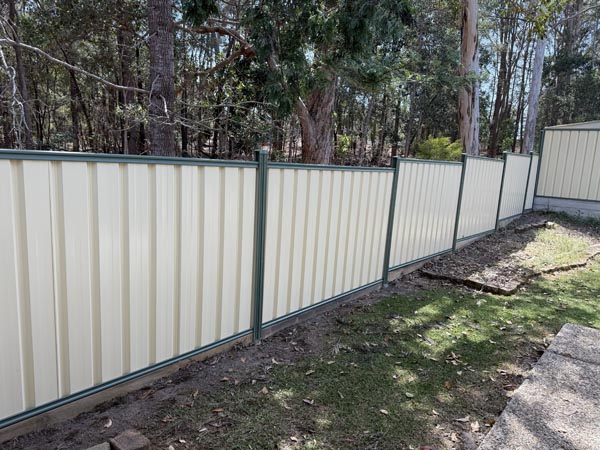
The trade-off is maintenance. Any repair work requires care. Spraying a cut edge on a panel risks overspray on a different-coloured post or rail. Masking is needed. Cardboard shields, tape, extra setup time.
Without that care, repairs can look blotchy or rushed. This is where many fences lose their original crisp appearance.
Dual tone works best when the owner understands that future touch-ups require more precision.
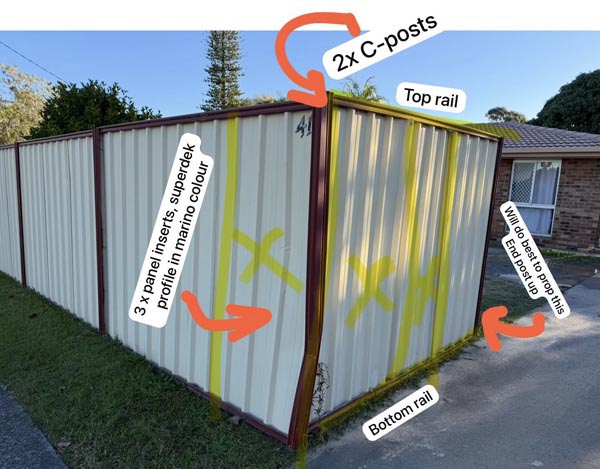
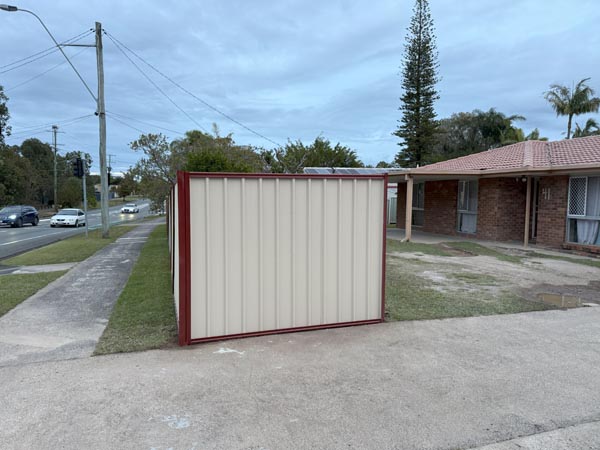
Then there’s heritage red / manor red – which is no longer provided as a standard Colorbond fence colour. When a repair means it’s not a choice though, it means considering a light base colour that allows me to spray paint to match, off site, ahead of time, away from the domain coloured panels.
Repairs, Touch-Ups, and Reality
No fence stays untouched forever. Lawnmowers flick stone and garden tools scrape panels.
Every fence I install has all cut edges sprayed with a matching corrosion-inhibiting paint. That’s straightforward with a single colour. With dual tone, it becomes a slower, more careful process.
This isn’t about cutting corners. It’s about recognising that simplicity often delivers the best long-term result.
Matching Existing Boundaries
Sometimes colour choice isn’t really a choice. If another boundary fence already exists, matching it is often the right call to maintain consistency, particularly in shared or visible areas.
In these cases, the maintenance implications still apply. It’s just a conscious compromise rather than an accidental one.
A Practical Recommendation
If you are open to choice and want the lowest maintenance option over the life of the fence, a single colour is hard to beat. It installs cleanly, repairs cleanly, and ages evenly.
Dual tone can look great. It just demands more care later.
Understanding that difference upfront helps you choose with clear eyes rather than discovering it the first time a repair is needed.